
FutureAir

Air conditioning has become a convenience that we take for granted across the United States. It is responsible for the comforts of modern living beyond just room temperature. And it is connected to almost every industry in ways that aren’t always visible. But it wasn’t always that way. A recent New York Times article titled “How Air Conditioning Conquered America (Even the Pacific Northwest),” by Emily Badger and Alan Blinder, tracks our dependence on air conditioning since the 1950’s—and it goes much deeper than you might expect.

Air conditioning has made economic growth practical in the hottest regions of the United States. “It made possible industrial work like printing, food processing and electrical manufacturing that would be hard to manage in sweltering heat. And it created the possibility for white-collar jobs in mechanically cooled office buildings.” Imagine production and progress being feasible in the humid south without central air.

Cooling technologies have everything to do with infrastructure and city planning. Sprawl is viable, and traffic is tolerable, because of air conditioning in cars. It made places like Phoenix, which is considered a relatively new city, possible. Types of building designs are also informed by air conditioning in regions like the Southwest, where wood housing is now used instead of just concrete construction.

Of course, these kinds of design decisions are problematic and unsustainable. “‘With the advent of air-conditioning, we lost a lot of the common sense,’ said Kirk Teske, the chief operating officer at HKS Architects, with headquarters in Dallas. He worries that regions like the Northeast may lose it, too, setting up future challenges for office workers and residents when blackouts or other natural disasters come.”

And individual air conditioning use is on the rise as global temperatures increase (which in turn contributes to global warming in that disastrous loop). Even regions that historically never relied on air conditioning are now closer to the consumption of hotter regions like the South. In the Midwest, central air is built into 94% of new single-family homes. And across the US, window units are used in older buildings. In the Pacific Northwest, where there have been record-breaking heat waves this summer, more and more households are purchasing these units. “In 1990, just a third of households there used central air or window units. Now twice as many do.”

Air conditioning is connected to all of our modern conveniences, the infrastructure of our cities, and the economic growth of our country, including our digital lives (cooling is necessary for server farms and data centers). Our reliance on air conditioning isn’t going to shrink, but we can think more conscientiously about our use and design, and create a new kind of common sense.


The irony that air conditioning contributes to global warming is hard to miss: as temperatures increase, the more we use air conditioning—and the more we use air conditioning, the more we heat the planet. And yet this piece of the puzzle is largely missing from the climate change dialogue. According to this New York Times article by Lisa Friedman, one reason is that coolant chemicals (refrigerants) don’t make for a very sexy dinner party conversation.

In 1987, the Montreal Protocol, an international treaty designed to protect the ozone layer by phasing out the production of numerous substances, namely CFCs, that are responsible for ozone depletion, was signed. Hydrofluorocarbons (HFCs) became the alternative. While HFCs are less directly harmful to the ozone layer, they are still greenhouse gases and, according to the EPA, are designated as having “high global warming potential (GWP).”

An amendment to the Montreal Protocol was reached in Kigali last year, geared to eliminate the use of HFCs. Another NYT article, reporting on the deal, states that HFCs “function as a sort of supercharged greenhouse gas, with 1,000 times the heat-trapping potency of carbon dioxide.” Phasing out HFC’s could mean “avoiding an estimated half degree Celsius of warming by 2100.” The richest countries, including the US, are supposed to freeze HFC consumption by 2018. But the United States’ relationship to this amendment is unclear at this point.

Reimagining cooling is essential to approaching the problem of climate change and one of the major factors that could lead to emission reduction. If we change how we cool ourselves, we could significantly lower our potential warming from the predicted 4 to 5 degree increase.

The Montreal Protocol caused such a shift in the production and science around cooling, motivated by our clear impact on the environment, that it gives this writer hope another agreement like it can be reached. The new amendment is one step of many, but it is a big step.

Factories that manufacture air conditioners are also a large contributor to carbon emissions. Friedman’s article goes on to discuss the efficiency of air conditioning production: demand for air conditioning is increasing, which means the energy needed for production will increase as well. “1.6 billion new air-conditioners by 2050 means thousands of new power plants will have to come on line to support them.”

The demand for air conditioning is growing rapidly. Without innovation, this will only contribute further to global warming, and hence to an even greater demand for cooling technologies—an endless loop. That’s why these issues of cooling chemicals and efficiency are starting to be approached in creative, interdisciplinary, and comprehensive ways, across the interconnected fields of science and design. Innovation and policy changes go hand-in-hand when it comes to air products, which, to me, is a pretty sexy dinner party topic.

Air conditioning and modern architecture are more connected than what you think and the article “How air conditioning shaped modern architecture – and changed our climate” proves it. The writer, Patrick Sisson, provides us with an entertaining and didactic tour around architecture, technology and air. What we found very exciting about this piece is that while Sisson demonstrates how numerous building typologies adapted to the sudden freedom provided by air conditioning, he also emphasizes that artificial cooling has fueled today’s energy and environmental crisis.

In other words: yes, air conditioning allowed architects to design towers without atriums or light wells; yes, air conditioning “meant workers didn’t need to sit near a window and hence “offices could suddenly have larger floorplates, encouraging collaboration and denser construction”; yes, air conditioning made sealed buildings possible –hence, receiving no city dirt and dust through open windows. But of course, all these “advantages” had a flipside: “The adoption of the “windowless wall” created the fluorescent-lit, dull and dim office spaces many workers abhor” and major health implications were derived from the unhealthy air quality inside closed-off buildings. But what’s even worst: “the most damaging part of this shift has been the cost, in energy and carbon emissions, of our cool new world. By 2014, 87 percent of U.S. homes had some form of air conditioning”. The cooling of buildings and vehicles in the United States “contributes to half a billion metric tons of carbon dioxide emissions every year. We consume more energy for residential air conditioning than all other countries combined, although, with other countries such as China and India in pursuit of glass-walled visions of modernity, that is going to change, and not in a good way. Due in large part to indoor climate control, buildings utilize half of total U.S. energy consumption”.

All in all, we certainly agree with Sisson when he states: “Air conditioning promised a cooler, more modern environment indoors. But unless architects and designers continue to develop more green, efficient ways to keep our buildings cool, it will be increasingly difficult to escape the warming environment outside”.

For the complete article click here.

Photo Credit: “Curbed”

“Every time air quality decreased by one standard deviation, we saw a 12% reduction in stock returns.”

Comparing daily data from the S&P 500 index with daily air-quality data from an EPA sensor close to Wall Street, Professor Anthony Heyes and his colleagues from the University of Ottawa found a connection between higher pollution and lower stock performance concluding that air pollution brings down the stock market.

Apparently being exposed to bad air can make you feel depressed which in turn can reduce your cognitive capability. Bad moods and lower cognitive capabilities tend to reduce the appetite for risk, associated with lower returns.

For the complete article, click here

Interview by Scott Berinato

To learn about some of Lovegrove’s most world changing and influential designs to date, including his exquisite Supernatural Chair (photographed above), read Part 2 of his Forbes feature here.

Located just outside of Jaipur, India, the Amer Fort, also known as the Amer Palace, was built in 1592 by Raja Man Singh, and remains in pristine condition today. Like many Indian palaces, buildings, and urban dwellings, the Amer Fort still benefits from some of the most traditional and exquisite air cooling technologies. By creating different rooms and places for different climates and temperatures, the Fort’s architects planned for the seasonal use of varying spaces throughout the palace grounds. For example, the “Pleasure garden” is located in the center of a lake and is used for exceptionally hot summer days. If the palace’s dwellers or visitors become uncomfortable outdoors, they can migrate to the center of the lake to cool off. Similarly, inside the Amer Fort movable screens and curtains were used to keep spaces like the emperor’s throne as cool as the open lake. As Vinod Gupta, Assistant Professor of Architecture at the School of Planning & Architecture in New Delhi, writes, “It is said that in summer there were three sets of screens used, two of them grass mats kept wet by sprinkling of water. Heavy quilted curtains were suspended in place of these screens in winter.” Additionally, one of the most fascinating air cooling technologies employed at the Amer Fort are the apertures, some of which are no larger than one centimeter, designed to let in air which then gets cooled within the larger structure of the building by filtering through an underground (and therefore shaded) tunnel where air flows over shaded water (pictured) to keep it cool.

While beginning to write this post I found myself struggling to employ the appropriate lexicon to describe the concept of air cooling without air conditioning, an area of study important to FutureAir but still somewhat obscure to an average city dweller like myself. As Gupta writes, the energy crisis has spurred the accumulation of a vast body of literature about “passive cooling systems,” or technology that cools air naturally and sustainably, but he argues that the strategies employed by indigenous Indian builders and architects remain the most developed. According to Gupta, “When [modern] architects talk of passive cooling, it is as if the maintenance of certain specified temperatures in a building is an end in itself. On the other hand, the indigenous builder could not care less if the building was cool or warm so long as people could be comfortable within or without the building.” Without electricity indigenous Indian architects used their knowledge of physics and the climate in which they lived to strive for comfortable and utilitarian structures, which are, as a result, quite beautiful.

REFERENCES
“Amer Fort.” Jaipur: The Pink City, August 24, 2016. http://www.jaipur.org.uk/forts-monuments/amber.html.
Gupta, Vinod. Energy and Habitat: Town Planning and Building Design for Energy Conservation. John Wiley & Sons (Asia) Pte Ltd, 1984.

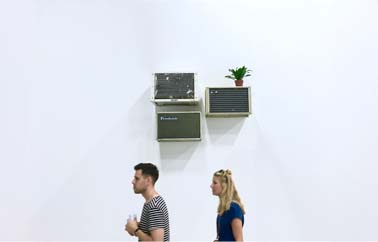
Mika Rottenberg’s work, The AC Trio, 2016 displayed at the Palais de Tokyo’s summer exhibition, Happy Sapien, inverts her viewer’s daily relationship to air conditioning by displaying the back end of three units inside the gallery space. By installing what most air conditioner users would consider to be the uglier side of their units which usually hang out of windows and always leak, Rottenberg isolates the grotesque aesthetics of the appliance by removing its usual function. With a small planter sitting atop the third unit in the trio, Rottenberg pokes fun at a meager attempt at integrating flora into the street-side of urban life. Below Rottenberg’s trio sit two pans atop hotplates and another plant. The filthy drip that every city dweller has experienced falls onto the pans that cook our food and the plants that hydrate our earth. The viewer may even begin to imagine the heat of the hotplates rising up into the units. By appealing to her viewer on a visceral level, calling to mind the use of daily objects and the flow of liquid, sound, and heat between them, Rottenberg begins to create an aesthetic of that which is omnipresent and yet invisible, air.

Ceiling Fan Composition #2, 2016, another of Rottenberg’s works displayed in Happy Sapien, is comprised of the colorful and vibrant display of the four fans behind the gallery wall. Like disco-balls rotating to an unseen rhythm, Rottenberg’s fans become mesmerizing, each illuminated by a different color of neon light. While the AC trio slowly drips filth, pushed out of someone’s window and spilling over into the gallery space, the fans spin together external to the gallery space in a neat composition. By encasing her fans outside of the room in which the viewer resides, Rottenberg, once again, removes their usual function. In so doing, she opens a space for the viewer to interact with air on an unusual level; aesthetically, rhythmically, and hopefully, with an eye toward the future of air.

Written by Tess Gruenberg and Francesca Michel

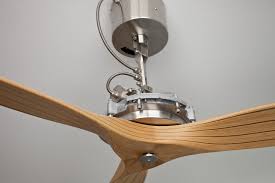
Civic Hall has a new addition to everyone’s favorite meeting room…a Boffi ceiling fan!

FutureAir’s sensing platform is now connected to a hand-crafted stunning ceiling fan to make it smarter while keeping guests cool in a sleek often occupied conference room where FutureAir has been collecting live data related to air quality and thermal comfort for the past few months.

FutureAir is piloting our own sensing technology in the beautiful Boffi ceiling fan – the first of a series of product partnerships, while we work on our own product line with Ross Lovegrove, FutureAir founder and renowned industrial designer.

Boffi is a high-end Italian kitchen and bathroom manufacturer, but happens to make what we think is the most beautiful fan on the market.

3,000 gallons.

According to the Environmental Protection Agency (EPA), that’s how much air we each breathe in a day. You would think that taking in that much of anything into your body would be worth pausing to consider. And yet, even though breathing is one of the most vital and fundamental functions of life, we rarely give much thought to the air that envelops us.

When people do stop to think about air pollution, what comes to mind is outdoor pollution, acid rain, or images of the Beijing skyline hidden beneath smog. However, air pollution also manifests indoors through wood, oil, household cleaners, and building materials, and can be anywhere from 2 to up to 100 times the outdoor level. And since we spend 90% of our time indoors, could this potentially have a major effect on our health and productivity?

This is what Aclima, an environmental health startup, aims to measure and discover. In 2015, Aclima announced a partnership with Google to monitor not only outdoor but also indoor environmental air quality using a network of sensors. 500 sensors are connected across 21 global Google offices in order to measure 500 million data points a day including temperature, humidity, noise, light and air pollutants. The data collected can update and monitor real­time air quality information through backend software. The ability to measure these factors can lead to decision useful information in designing workspace and promoting the comfort, welfare and productivity of employees.

Resources:

Environmental Sensor Startup Aclima Is Studying The Air Googlers Breathe


https://aclima.io/blog/posts/aclima-google-map-air-quality/
http://www3.epa.gov/air/basic.html

Photo credit: TechCrunch

Taking on Indoor Air

From a short visit to a remote village in South America emerged the seed of an idea.

In an otherwise exquisitely designed yet simple home, I experienced the unexpected and fantastic feeling of no temperature at all, of perfect comfort. A combination of natural airflow and a simple ceiling fan made this happen.

Nevertheless, the conventional ceiling fan above was a visual eyesore in contrast with surrounding well-designed interior space. The ceiling fan, still a basic propeller form, was dated and old-fashioned.

At FutureAir, we are reimagining indoor air. Our mission is to improve indoor air quality comfort and energy efficiency.

On the FutureAir blog we will share a collection of ideas, news and research to keep you informed on all things air related to design, science, technology and the environment. We’ll also give you an inside look into what we are working on and thinking about at FutureAir.

If you want more information, have a question or there’s something you’d like us to write about, just leave a comment on one of our posts. We’d love to hear from you.