RESET Indoor Air Quality
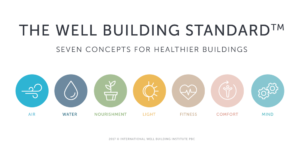
Now, indoor air quality is something that we have discussed previously on our blog. In fact, indoor air quality is the foundation of FutureAir, so the RESET Air Standard is right up our alley. RESET is an Indoor Air Quality (IAQ) certification administered by GIGA. GIGA is an organization that measures the effect of the built environment on human health. RESET, like WELL, places human health at the center of building design. However, RESET is specifically focused on clean indoor air.Let us refresh about the importance of indoor air quality. First of all, we spend 90% of our time indoors! Research has shown that improving indoor air quality can improve human health. Additionally, improving indoor air quality serves to improve productivity amongst workers. Cleaning our indoor air is a preventative measure that results in a healthier community and a more efficient economy.
RESET’s air quality measurements come from data accumulated over a three month period. Other green building certifications rely on data from a single day–perhaps even a few hours of a day. The three-month long data collection paints a more accurate picture of the long-term indoor air environment. Furthermore, the ongoing data collection allows for occupants to understand the air quality fluctuations within their space and learn how to improve air quality. This ongoing quality control suits the human learning curve and encourages behavior change.
How Does It Work?
The RESET air standard is broken down into two categories–Commercial Interiors (CI) and Core&Shell (CS). The RESET Air CI focuses on individual interiors and their health effects on occupants. The RESET Air CS monitors the health performance of entire buildings.Unlike other green building certifications, RESET does not have a fixed certification standard. Instead, RESET is performance-based driven by technological measurements. The certification takes into consideration the fluctuations within spaces. Therefore, the certification accounts for the ebb and flow of air quality over time. The certification falls to the individuals to make a case for their projects. Additionally, the certification must be renewed annually.
In order to achieve certification, a project must meet air quality standards as defined by industry best-practices and international standards. Indoor air quality is tracked by RESET certified monitors and averaged for a daily measurement. The average must fall within RESET’s parameters.
RESET IAQ Measurements
RESET evaluates the PM2.5 (Particulate Matter 2.5), TVOC (Total Volatile Organic Compounds), CO2 (Carbon Dioxide), CO (Carbon Monoxide), Temperature, and Relative Humidity. The acceptable measurement for PM2.5 is less than 35 μg/m3 and for TVOC is less than 500 μg/m3. CO2 must fall below 1000 parts per million and CO below 900 parts per million. If a building meets these measurement standards on average it meets certification. RESET also lists High-Performance targets for buildings that meet a more rigorous standard.In order to measure IAQ, buildings must use Grade A (calibration grade) or Grade B (commercial grade) monitors. In other words, the RESET certification is separate from the technology used to monitor the air. The technology is a third-party resource and expenditure. The certification reviews the IAQ measurements in relation to the defined space and the total number of occupants of the building. 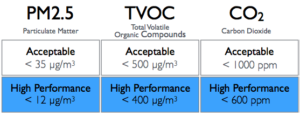
RESET in the Built Environment
RESET has human health benefits as well as economic benefits. RESET certified buildings attract more tenants, retain more employees, and reduce building insurance costs. Recently, as of October 2018, RESET and WELL partnered up to align certification processes in order to capitalize on each certifications strengths. Anjanette Green, of RESET, stated, “This cooperative spirit is exactly what makes me so excited and optimistic for the future of architecture and design.” This collaboration makes human health improvements more accessible and achievable!Written by Mollie Wodenshek for FutureAir
Resources:
“About GIGA,” GIGA.
PureLiving, “LEED, WELL, RESET – What is the Difference?”, PureLiving: Indoor Environmental Solutions.
“RESET Air v2.0: How to Meet New Standards for Commerical Interiors,” Kaiterra.
“RESET Air Standard for Commercial Interiors v2.0,” RESET.
“WELL and RESET align to make both certifications easier for project teams,” International WELL Building Institute.
Photos:
RESET